


Sahas Urja Q3 FY 2082/83 Net Profit Jumps to Rs. 1.18 Arba - 42% YoY Higher
Sahas Urja Limited (SAHAS) has posted Q3 FY 2082/83 net profit of Rs. 1.18 arba - up 41.78% from Rs. 83.42 crore ...

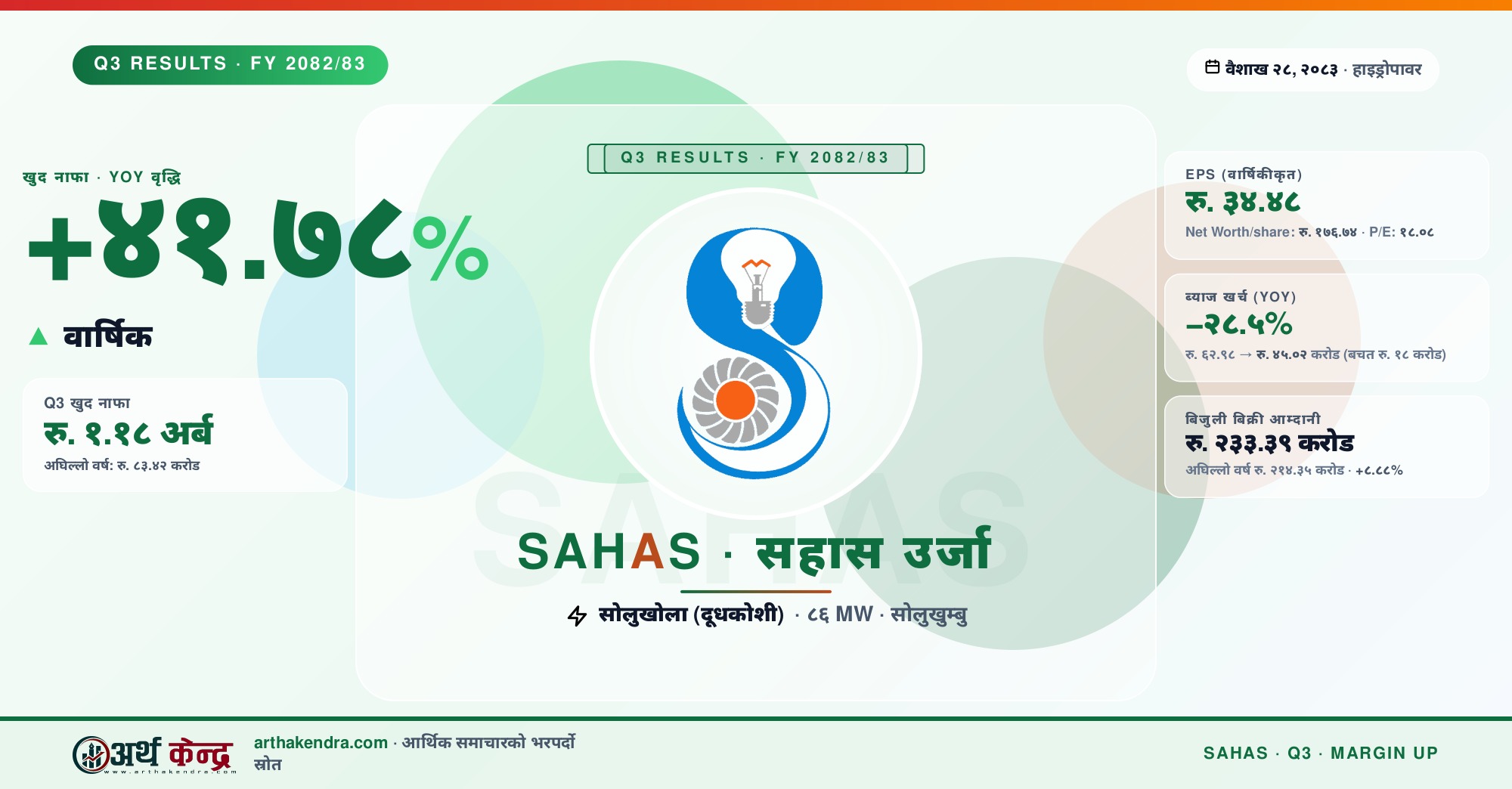
Kathmandu - Sahas Urja Limited (SAHAS), operator of the Solu Khola (Dudhkoshi) 86 MW hydropower plant, has published its unaudited Q3 financial statements for FY 2082/83 (period ending 30 Chaitra 2082 / 13 April 2026). The headline - net profit climbed from Rs. 83.42 crore last year to Rs. 1 arba 18 crore 27 lakh this year, a 41.78% year-on-year jump.
What's interesting is that the revenue line didn't grow nearly as fast. Electricity-sale revenue rose only from Rs. 214.35 crore to Rs. 233.39 crore - an 8.88% increase. That makes sense - SAHAS's operating asset is a run-of-river plant, and river flows this year were a bit lower than last year, which gradually weighed on generation. Whatever was generated continues to sell to NEA under the PPA, with payments on schedule.
It Wasn't Revenue - It Was Cost Discipline
| Item | Q3 2082/83 | Q3 2081/82 | Change |
|---|---|---|---|
| Revenue from electricity | Rs. 233.39 cr | Rs. 214.35 cr | +8.88% |
| Gross Profit | Rs. 172.83 cr | Rs. 155.24 cr | +11.33% |
| Operating Profit | Rs. 166.72 cr | Rs. 148.72 cr | +12.10% |
| Administrative Expenses | Rs. 4.95 cr | Rs. 5.75 cr | −13.95% |
| Finance (Interest) Costs | Rs. 45.02 cr | Rs. 62.98 cr | −28.5% |
| Profit Before Tax & Staff Bonus | Rs. 121.93 cr | Rs. 85.74 cr | +42.21% |
| Net Profit | Rs. 118.27 cr | Rs. 83.42 cr | +41.78% |
The single biggest contributor is the drop in interest cost - down from Rs. 62.98 crore to Rs. 45.02 crore, saving roughly Rs. 18 crore in one quarter. The savings come from a falling Bridge Gap Loan balance and a lighter medium/long-term loan stack (Rs. 868.14 crore → Rs. 845.39 crore). Admin expenses were also 14% lower YoY, and gross margins widened because direct expenses grew slower than revenue.
The Three-Year Picture
This improvement didn't appear overnight. Looking across three years of Q3 data, the trend is consistent:
| Item | Q3 2080/81 | Q3 2081/82 | Q3 2082/83 |
|---|---|---|---|
| Revenue from electricity | Rs. 202.53 cr | Rs. 214.35 cr | Rs. 233.39 cr |
| Operating Profit | Rs. 140.48 cr | Rs. 148.72 cr | Rs. 166.72 cr |
| Finance Cost (interest) | Rs. 91.68 cr | Rs. 62.98 cr | Rs. 45.02 cr |
| Net Profit | Rs. 47.82 cr | Rs. 83.42 cr | Rs. 118.27 cr |
In two years, interest cost has fallen from Rs. 91.68 crore to Rs. 45.02 crore - roughly halved. That's the entire SAHAS story right now - large construction-era debt is being progressively paid down, and the savings are flowing straight to the bottom line.
EPS, Book Value and Per-Share Snapshot
| Metric | Q3 2082/83 | Q3 2081/82 | Change |
|---|---|---|---|
| EPS (annualised) | Rs. 34.48 | Rs. 29.42 | +17.20% |
| Net Worth per Share | Rs. 176.74 | Rs. 182.18 | −2.99% |
| Total Assets per Share | Rs. 405.28 | Rs. 469.26 | −13.63% |
| P/E Ratio (annualised) | 18.08 | 17.03 | +6.17% |
| Liquidity Ratio | 0.53 | 0.48 | +10.42% |
The 17% EPS jump is impressive when you remember the company issued a 21% bonus share in between. Bonus issuance expands the share count - so if earnings don't grow proportionally, EPS can actually fall. SAHAS grew earnings faster than the dilution, so EPS still moved up.
Net worth per share moved down slightly (Rs. 182.18 → Rs. 176.74) because the bonus expanded the equity base. Liquidity ratio improved from 0.48 to 0.53 - a small positive.
Bonus & Rights
SAHAS has been actively expanding its capital base. FY 2080/81 AGM approved an 8% bonus share and a 1:1 rights issue (both completed). Then the FY 2081/82 AGM (held 25 Magh 2082) approved a fresh 21% bonus share, listed on NEPSE on 26 Magh 2082.
Now the company is preparing another 1:1 rights share on the new post-bonus paid-up capital. The Electricity Regulatory Commission (ERC) granted pre-approval on 17 Falgun 2082; the proposal is pending Securities Board of Nepal (SEBON) clearance.
Paid-up capital today is Rs. 457.38 crore; last year at the same time it was Rs. 378 crore (21% higher after the bonus). If the rights goes through, paid-up could roughly double again.
Pipeline: Buddhi Gandaki 341 MW
The long-term growth story sits with subsidiary Times Energy Pvt. Ltd., developing the Buddhi Gandaki Hydropower Project (BGHEP) - 341 MW (PROR / peaking run-of-river type). Preliminary works are underway, design is in its final phase, staff have been mobilised at site, and residential construction is in progress. If completed, BGHEP would more than quadruple SAHAS's capacity from today's 86 MW.
The accounting move tells the story - Times Energy was previously held as an Investment in Associates at Rs. 93.16 crore (minority stake). It has now been reclassified to Investment in Subsidiary at Rs. 216.18 crore - +132%. In other words, SAHAS has bumped its stake to majority and is taking the lead on Buddhi Gandaki. Project development cost (BGHEP) also climbed from Rs. 4.21 crore to Rs. 10.76 crore (+156%).
Balance Sheet Snapshot
| Item | Q3 2082/83 | Q3 2081/82 | Change |
|---|---|---|---|
| Total Assets | Rs. 1,853.68 cr | Rs. 1,773.78 cr | +4.50% |
| Shareholder's Fund | Rs. 807.85 cr | Rs. 688.11 cr | +17.40% |
| Medium & Long-Term Loan | Rs. 845.39 cr | Rs. 868.14 cr | −2.62% |
| Bridge Gap Loan | Rs. 187.30 cr | Rs. 205.30 cr | −8.77% |
| Cash & Cash Equivalents | Rs. 35.03 cr | Rs. 30.96 cr | +13.14% |
The Analyst Read
SAHAS's Q3 numbers showcase the textbook hydropower payoff curve - once a project is built and revenue-generating, debt paydown and falling interest costs progressively widen profit margins. The three-year trend confirms it: net profit has gone Rs. 47.82 cr → Rs. 83.42 cr → Rs. 118.27 cr. Pushing revenue higher needs river flow (and weather); cost discipline is in management's hands - and SAHAS has shown it consistently.
What investors should watch from here: (a) when SEBON clears the 1:1 rights issue; (b) the financial closure for BGHEP; (c) Q4 flow and the full-year generation print; (d) whether the interest-cost glide path continues - if it does, FY 2083/84 net profit could look even more interesting.
Comments
0 comments · join the conversation
No comments yet
Be the first to share your thoughts.
Add a comment
Your comment will appear after a quick review.
Comment submitted
Thanks! Your comment is in the moderation queue and will appear after verification.
Reply to comment
0 replies
Reply submitted
Thanks! Your reply is in the moderation queue and will appear after verification.