


Government Plans Final Tax on Net Profit from Share Transactions
The government is set to move forward with a system that imposes capital gains tax only on net profits, after adjusting for gains and losses from securities transactions.

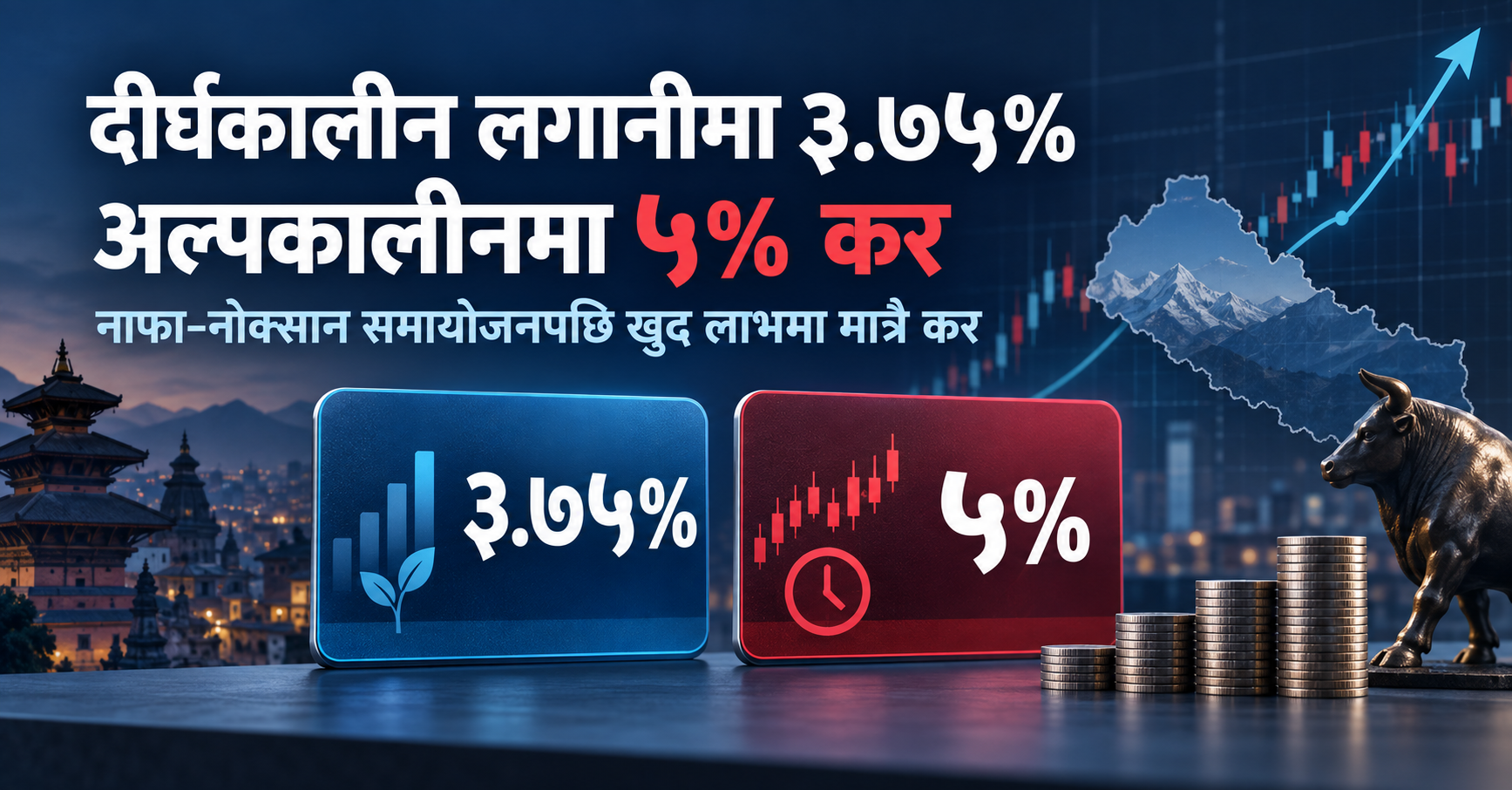
Kathmandu - The government is set to move forward with a system that imposes capital gains tax only on net profit after adjusting for gains and losses from securities transactions. The Ministry of Finance has mentioned in its publicly released 'Capital Market Strengthening and Revitalization Plan, 2083' that it will reform the existing tax system to encourage long-term investments.
According to the plan, the current tax rate will be maintained for resident individuals selling shares or other interests of companies listed on the Nepal Securities Board. A 3.75 percent tax will be proposed on profits from securities held for more than 365 days, while a 5 percent tax will be proposed on profits from securities held for 365 days or less.
This system aims not just to change tax rates but to improve the process of tax calculation and adjustments for gains and losses. Even though tax is deducted on every profitable transaction, investors have complained about not being able to effectively adjust losses from other transactions within the same tax year. The new system envisions matching profits and losses from securities transactions done within the same tax year through a reconciliation system.
The plan has proposed studying the provision that allows resident natural persons or resident entities who pay tax, according to subsection 2 of Section 95 of the Income Tax Act, to benefit from loss adjustments. If there is a loss calculated under Section 37 from the sale of listed securities in the relevant tax year, arrangements will be made to adjust it with the profits from securities transactions of the same year.
Accordingly, only if there is a net profit visible from the transactions throughout the year will the capital gains tax be collected as a final tax at the determined rate. For example, if an investor experiences a profit of two lakh rupees and a loss of eighty thousand rupees from transactions subject to the same tax rate within a tax year, the net profit would be one lakh twenty thousand rupees. The proposed concept expects this net profit to be the basis for tax calculation. However, the detailed calculation method will be determined by final laws, procedures, and systems.
When the new system is implemented, active investors will be able to adjust losses from that year's transactions even when paying tax on profitable transactions. The government expects this will reduce the problem of having a greater tax burden than actual net profit, and also help further streamline transaction records, tax calculations, and reconciliation processes.
With a preferential tax rate of 3.75 percent for long-term investments, it is expected that investors will be encouraged to hold shares for more than a year. On the other hand, transactions of one year or less will be considered short-term with a 5 percent tax. This clearly indicates the government's policy to prioritize long-term capital mobilization in the market.
However, the plan has not provided detailed processes on how to adjust taxes deducted during transactions at the end of the year, how to refund if excess tax is deducted, or how to adjust combined losses from long-term and short-term transactions. These issues will be clarified after studies on capital gains tax calculation methods, legal reforms, and the development of transaction and reconciliation systems.
Execution of the proposal will require coordination between tax administration, the Nepal Stock Exchange, CDS and Clearing, securities brokers, and transaction details of investors. Just because it is mentioned in the plan does not mean the new system will be immediately implemented. Investors will be able to enjoy the benefit of loss adjustment only after necessary legal and technical arrangements are implemented.
Comments
0 comments · join the conversation
No comments yet
Be the first to share your thoughts.
Add a comment
Your comment will appear after a quick review.
Comment submitted
Thanks! Your comment is in the moderation queue and will appear after verification.
Reply to comment
0 replies
Reply submitted
Thanks! Your reply is in the moderation queue and will appear after verification.