

India Announces Rs 240 Billion Development Package for Nepal; Eight MoUs Signed During PM Shah's Visit
The foundation stone of the 669 MW Lower Arun was laid, but the grant–loan split of the aid is yet to be disclosed.
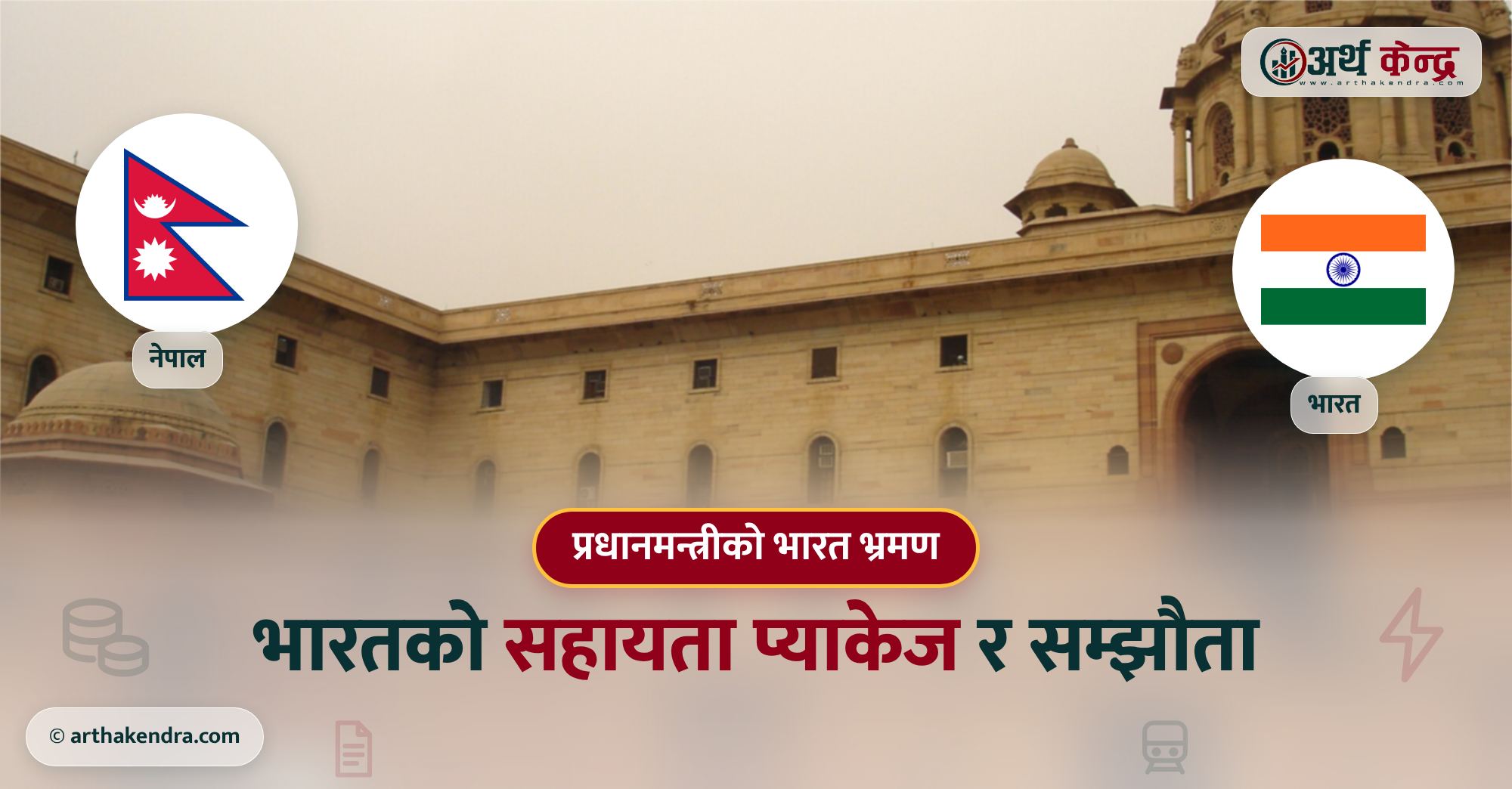
Kathmandu. India has announced a development cooperation package of 24,000 crore Nepali rupees, or Rs 240 billion, for Nepal. Indian Prime Minister Narendra Modi made the announcement at a joint press meet at Hyderabad House in New Delhi on Monday, November 23, the second day of Prime Minister Balendra Shah's two-day state visit to India.
Modi said the money is meant for reconstruction and long-term development after the Bhotekoshi–Trishuli floods of late August. In the presence of the two prime ministers, the two sides exchanged eight MoUs and agreements, and launched energy, petroleum and border infrastructure projects, including the 669 MW Lower Arun hydropower project.
Modi described Nepal–India ties as rooted in kinship and unbreakable trust, and said India would stand by Nepal in difficult times.
Package: Grant and Loan Split Not Yet Disclosed
It has not yet been disclosed how much of the package will come as grants and how much as concessional loans (lines of credit). Details of which projects the money will fund have not been made public either.
Ahead of the visit, Nepal had sought $2 billion in grants and concessional loans to rebuild flood-damaged infrastructure and finance large projects. During his 2014 visit to Nepal, Modi had announced a $1 billion concessional line of credit for Nepal.
Lower Arun Foundation Stone Laid, Pipeline Phase II Inaugurated
The two prime ministers virtually laid foundation stones for, and inaugurated, projects backed by Indian assistance and investment from Hyderabad House.
Lower Arun Hydropower Project
The 669 MW Lower Arun, to be built by India's state-owned Satluj Jal Vidyut Nigam (SJVN), is estimated to cost Rs 92.67 billion. Its main structures will be in Chichila Rural Municipality and Khandbari Municipality of Sankhuwasabha, and it is targeted for completion in five years.
Built as a cascade of the 900 MW Arun-III project, Lower Arun will give Nepal 21% of its electricity free of cost. The rest will be exported to India.
Petroleum and Border Infrastructure
The second phase of the Motihari–Amlekhgunj petroleum pipeline was inaugurated. Foundation stones were laid for a petroleum terminal at Charali, Jhapa, under the Siliguri–Charali petroleum pipeline, and for an Integrated Check Post (ICP) at the Banbasa border point. A motorable bridge linking Darchula and Dharchula was also part of Monday's programme.
The two prime ministers also virtually launched the Saryu–Kamala Express train between Ayodhya and Janakpurdham.
Eight MoUs: From Space to Livestock
Satellite communication: Between the Indian Space Research Organisation (ISRO) and Nepal's Ministry of Information and Communication, to set up a satellite communication (SATCOM) network for using the South Asia Satellite.
Forensic science: Academic and research collaboration between the National Forensic Sciences University, Gujarat, and the Crime Investigation Department of Nepal Police.
Police training: Between India's Rashtriya Raksha University and Nepal's National Police Academy.
Civil service training: A capacity-building programme between India's National Centre for Good Governance and the Nepal Administrative Staff College under the Ministry of Federal Affairs and General Administration.
Health and medicine: Cooperation between the health ministries of the two countries.
Ayurveda and traditional medicine: A government-to-government cooperation agreement.
Sustainable urban development: Technical cooperation between the two governments.
Livestock and fisheries: Development cooperation between the two governments.
No Agreement Announced on Air Routes
No agreement has been made public on the additional air entry routes via Bhairahawa, Nepalgunj, Mahendranagar and Janakpur that Nepal had listed as a top priority for the visit.
At the joint press meet, Prime Minister Shah said the two countries should move towards direct air connectivity between their cities for easier travel by citizens. Modi's address did not mention air connectivity.
Comments
0 comments · join the conversation
No comments yet
Be the first to share your thoughts.
Add a comment
Your comment will appear after a quick review.
Comment submitted
Thanks! Your comment is in the moderation queue and will appear after verification.
Reply to comment
0 replies
Reply submitted
Thanks! Your reply is in the moderation queue and will appear after verification.